Pope Francis thanks Jains for Commitment to Care for the Planet

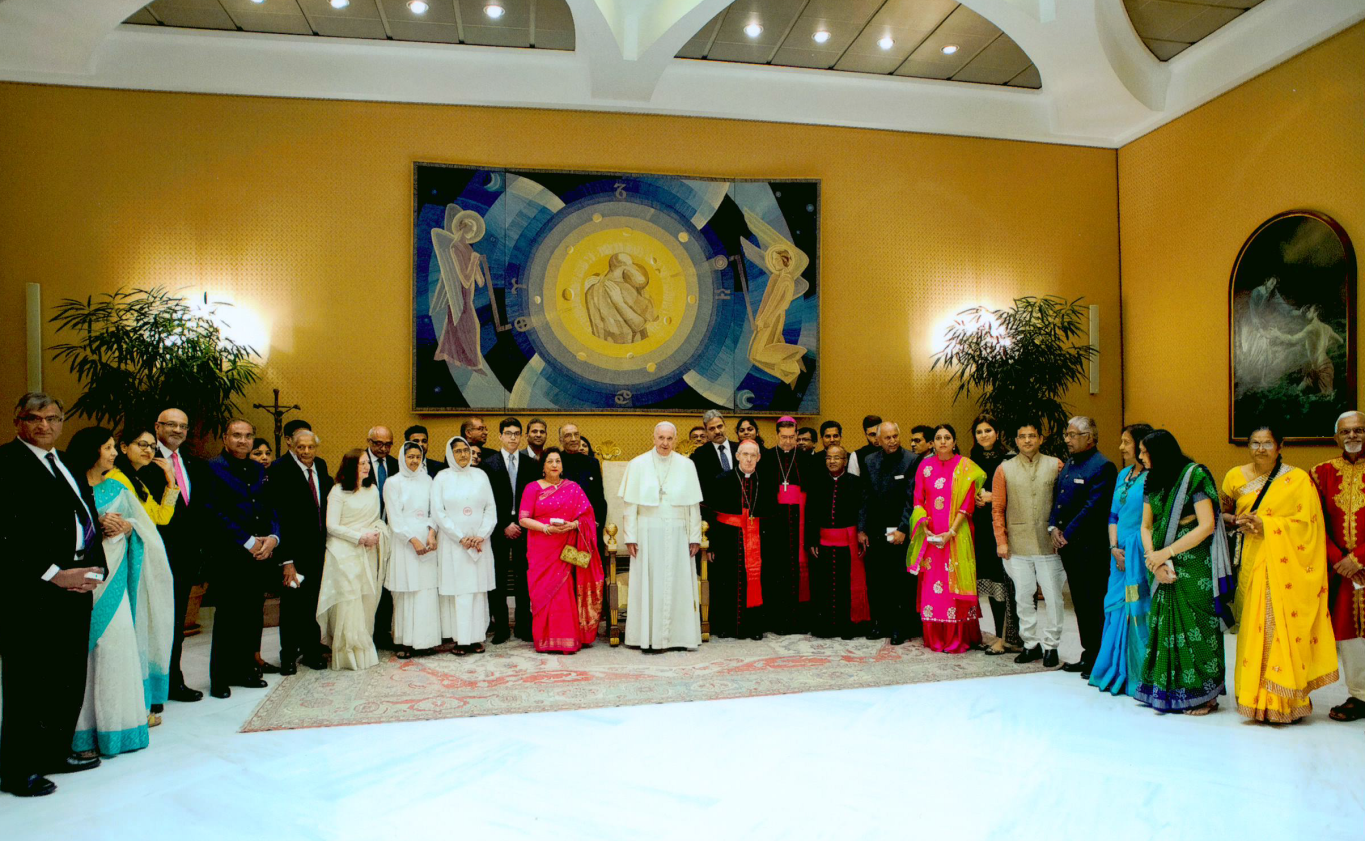
Pope & Jains.png

AIA Member organisation, the Institute of Jainology (IoJ) met with Pope Francis at the Vatican on 1 June 2016.

       The Institute of Jainology (IoJ), the international Jain organisation promoting Jainism in government and inter-religious affairs, led its third delegation to the Vatican to meet with the Pontifical Council for Inter-religious Dialogue (PCID). The last two meetings were in 1995 and 2011. 
       The 35- strong international Jain delegation was led by Mr Nemu Chandaria, Chairman of the IoJ and had Jain leaders from the UK, India and the Middle East. The delegations discussed the topic of ‘Taking care of the Earth, the home of the human family’. Dr Mehool H Sanghrajka, Director of the IoJ, presented a paper from the Jain perspective in which he said; “The signs of our environmental damage are all around us. Degradation of the environment and climate change are already causing great suffering. Unchecked consumerism and wastefulness, the hallmarks of modern life, continue to cause irreparable damage to the planet. From a Jain perspective, taking care of the earth is not merely concern for the environment. It is far deeper, and rooted at the heart of Jain preaching. Co-existing with all other forms of life in an interdependent world, is about not causing harm to our fellow souls, and sin to one’s self.” 
       The Jain delegation and the PCID issued a joint press communique in which they called upon ‘the followers of both religious traditions to promote respect for the environment, non-exploitation of natural resources, reduction of wastefulness, care for all forms of life, and concern for future generations’. The full text is available here. 
      Following the meeting, the delegation had a private audience with HH Pope Francis.  Expressing his joy at the encounter, Pope Francis welcomed the Jains saying that “this encounter nurtures our responsibility to care for creation”, and calling creation a “gift that we have all received” he said “creation is God’s mirror, the mirror of the Creator, the mirror of nature, and it is our mirror too.” 
      “We all love mother Earth, because she is the one who has given us life and safeguards us; I would also call her sister Earth, who accompanies us during the journey of our existence. Our duty is to take care of her just as we would take care of a mother or of a sister, with responsibility, with tenderness and with peace” he said. His Holiness’ comments were reported on the Radio Vatican site. 

      Mr Nemu Chandaria, Chairman of the IoJ, commented; “We have mutual respect and friendship with the Catholic Church that has been built over two decades. We look forward to deepening cooperation at local levels whilst calling for responsible stewardship of the natural world”. 

      The Institute of Jainology (IoJ) was founded in 1986 and is an international organisation promoting Jain philosophy and values through the disciplines of art, culture and education. It represents the Jain faith in government and inter-faith matters in the UK and elsewhere.  Over its 25 year history, the IoJ has co-hosted the Peaceful Liberators exhibition at the Victoria and Albert Museum London, published the Catalogue of the Jain Collection at the British Library, and launched the Jainpedia.org encyclopaedia.  For more information see http://www.jainology.org and http://www.jainpedia.org.


Humane Revolution Lifts Animals and Us


cropped-baby-elephant1.jpg

From Houston Chronicle Newspaper, may 17, 2016

Nicholas Kristof says animal rights activists are working with corporations to change behavior and supply lines.

   In 1903, New Yorkers executed an elephant on Coney Island, effectively torturing her to death.

   Accounts vary a bit, but it seems Topsy was a circus elephant who had been abused for years and then killed a man who had burned her on the trunk with a cigar. After her owners had no more use for her, Topsy was fed cyanide, electrocuted and then strangled with a winch. The Edison motion picture company made a film of it, “Electrocuting an Elephant.”

   So maybe there is an arc of moral progress. After many allegations of mistreatment of animals, Ringling Bros. this month retired its circus elephants, sending them off to a life of leisure in Florida. SeaWorld said this spring that it would stop breeding orcas and would invest millions of dollars in rescuing and rehabilitating marine animals.

   Meanwhile, Wal-Mart responded to concerns for animal welfare by saying last month that it would shift toward cage-free eggs, following similar announcements by Costco, Denny’s, Wendy’s, Safeway, Starbucks and McDonald’s in the U.S. and Canada.

   This is a humane revolution, and Wayne Pacelle, president of the Humane Society of the United States, has been at the forefront of it. Alternately bullying companies to do better and cooperating with those that do so, he outlines his approach in an excellent new book, “The Humane Economy.” These corporate changes have vast impact: Wal-Mart or McDonald’s shapes the living conditions of more animals in a day than an animal shelter does in a decade.

   There is also a lesson, I think, for many other causes, from the environment to women’s empowerment to global health: The best way for nonprofits to get large-scale results is sometimes to work with corporations to change behavior and supply lines — while whacking them when they resist.

   The Environmental Defense Fund and Conservation International do something similar in the environmental space, CARE works with corporations to fight global poverty, and the Human Rights Campaign partners with companies on LGBT issues.

   Critics sometimes see this as moral compromise, negotiating with evil rather than defeating it; I see it as pragmatism. Likewise, Pacelle has been a vegan for 31 years but cooperates with fast-food companies to improve conditions in which animals are raised for meat.

   At a time when the world is a mess, Pacelle outlines a hopeful vision. The public has always had some impact with charitable donations, and there have always been occasional boycotts, but sometimes its greatest influence comes by leveraging daily consumer purchasing power.

   “By every measure, life will be better when human satisfaction and need are no longer built upon the foundation of animal cruelty. Indefensible practices will no longer need defending.”

   It’s true that atrocities continue and that the slaughter of animals like elephants persists. There were some 130,000 elephants in Sudan 25 years ago, while now there may be only 5,000 in Sudan and the country that broke off from it, South Sudan.

 Yet there is a business model for keeping grand animals like elephants alive. One analysis suggests that a dead elephant’s tusks are worth $21,000, while the tourism value of a single living elephant over its lifetime is $1.6 million. Countries follow their enlightened self-interest when they protect elephants, just as McDonald’s pursues its self-interest when it shifts toward cage-free eggs.

   It’s also astonishing how sensitive companies are becoming to public opinion about animals. After Cecil the lion was shot dead in Zimbabwe, animal protection groups lobbied airlines to ban the shipment of such trophies. Delta, American, United, Air Canada and other companies promptly obliged.

   In the pet store business, two chains — PetSmart and Petco — have prospered without accepting the industry’s norm of selling dogs and cats from puppy mills and other mass breeders. Instead, since the 1990s they have made space available to rescue groups offering animals for adoption. PetSmart and Petco don’t make money off these adoptions, but they win customer loyalty forever, and they have helped transfer 11 million dogs and cats to new homes.

   I believe that mistreatment of animals, particularly in agriculture, remains a moral blind spot for us humans, yet it’s heartening to see the consumer-driven revolution that is underway.

   “Just about every enterprise built on harming animals today is ripe for disruption,” Pacelle writes. In a world of grim tidings, that’s a welcome reminder that there is progress as well. We’ve gone in a bit more than a century from making a movie about torturing an elephant to sending circus elephants off to a Florida retirement home. But, boy, there’s so much more work to do.

   Kristof is a New York Times columnist.

Is Brexit Good for Animal Welfare?

Sheep

On the 23rd June 2016, UK citizens will be asked to vote in a referendum as to whether the UK should remain a member of the European Union (EU) or not. There are many factors to take into account when deciding which way to vote, but we consider animal welfare to be a very important one. Whilst we remain neutral on the referendum, we would like to present a few facts that concern animal welfare:

Animal Welfare legislation:

The EU has created a considerable amount of animal welfare legislation over the last three decades which has protected animals across Europe and made up around 80% of UK animal welfare law.1 Much of this has been led by Eurogroup for Animals, although the UK has been a driving force, with organisations like the RSPCA and CIWF providing the scientific evidence to base the legislation on. Outside of the EU, the UK may be less able to influence the European Commission and the 27 other EU member countries on animal welfare legislation.

Additionally, outside the EU, the UK would not benefit from EU animal welfare legislation and, according to CIWF, some other EU countries, such as Germany, have taken over from the UK as the main drivers of animal welfare.2

EU legislation achieved for animals includes the following:

  • Sow stalls banned
  • Battery cages for egg production banned
  • Import of cat and dog fur banned
  • Import of seal products from commercial seal hunts banned
  • EU members banned from killing whales
  • Import of whale products banned
  • EU members must sign up to EU zoo and farm animal rules
  • Steel-jawed leg-hold traps banned
  • Testing of cosmetics on animals banned
  • Driftnets banned, protecting countless sea mammals
  • Importation of wild birds into the EU banned
  • Protection given for habitats to conserve wildlife and protect migrating birds

Membership of the EU does not prevent countries from producing their own higher animal welfare standards. EU legislation imposes the minimum standards required for animal welfare and member countries can write higher animal welfare standards into their own legislation. EU member states may also draw up their own animal welfare legislation in areas not covered by the EU, such as the UK’s law on hunting with dogs or fur farming.

Sentient Beings

There is a legal obligation under the EU Treaty to consider animals as sentient beings when drawing up legislation. Before this animals were legally considered as objects.

Live Exports

Some people are claiming that the UK is not able to stop cruel live exports from the UK because of EU free trade rules. CIWF have examined this and have concluded that, if the UK were to exit the EU, they would still be restricted by World Trade Organisation (WTO) rules.2 However, countries can make their own agreements with other EU member states, which could include the banning of live exports.

Restriction of Low Welfare Imports

Some people are also claiming that the UK is not able to restrict imports of goods that do not meet UK animal welfare standards, due to EU free trade rules. Again, if the UK were to exit the EU, they would still be constrained by WTO rules. Countries are also free to negotiate their own trade agreements with each other.


Notes:

  1. http://blogs.rspca.org.uk/insights/2016/04/13/the-eu-referendum-and-animal-welfare/#.VzcvHMv2azk
  2. http://www.ciwf.org.uk/news/2016/03/compassion-explores-the-pros-and-cons-of-brexit 

EU In or Out – What’s Best for the World’s Animals?

PigOn 20 February, David Cameron announced that the UK’s in/out referendum would be held this year, on the 23rd of June.

AIA member organisation, Quaker Concern for Animals (QCA), has solicited views from a number of prominent animal advocates and animal protection organisations, in the interest of providing as comprehensive an overview as possible for their members and website visitors.

AIA and QCA do not endorse any of the specific views presented here.  They are listed in the order QCA received response.

The issues are many and complex and it QCA’s hope that in providing access to these viewpoints they will be helping individuals inform themselves as fully as possible on the matter, as they seek guidance both temporal and spiritual for the good of the worlds’ peoples and its animals.

QCA hope to add to this article as they receive responses and permission from additional parties they have contacted.  They will notify their facebook likers and twitter followers as new submissions are posted.  For future updates please see http://quaker-animals.co.uk/2016/04/eu-in-or-out-whats-best-for-the-worlds-animals/


>     ANIMAL AID

This is a very complex issue and, in short, we cannot make a confident judgement of the consequences.  As well as issues of animal protection there is the question of the subsidising regime that will replace CAP.  While CAP has been generous to industrial scale farming, UK governments have always been intent on feather-bedding arable and animal producers. 

When it comes to animal protection issues, outcomes depend on the policy issue or legislation under consideration and the campaigning/lobbying effort people put into it.

In countries like Britain, animal protection issues have long been debated and battled over politically and commercially, and legislation coming out of the EU tends to have little real impact. However, for countries where there is little to no tradition of animal protection, the EU can provide a platform for substantial welfare advances. This is the case, for instance, with the recently introduced legal framework governing animal experiments [Directive 2010/63/EU]. But while the EU has the potential to take things forward in this way, because so many states and commercial vested interests are involved in the haggling process, new laws can take literally years, even decades, to emerge. And inevitably they get watered down, as did the recently introduced regulation on the welfare of egg-laying hens [Directive 1999/74/EC], which saw ambitions for a complete ban on battery cages reduced to mere tinkering with the design of the cages.

Clearly if we separate from the EU, this dynamic will not apply insofar as Britain is concerned. We then have a free hand to either move in a progressive or reactionary direction without, it might be argued, the restraining/guiding hand of the EU.


>     KENT ACTION AGAINST LIVE EXPORTS

Ian and I will be voting to leave because we have campaigned for the last 20 years to stop the export trade and we are constantly told that the UK is prevented from banning the trade due to the Treaty of Rome.

Even though the Treaty of Lisbon made animals sentient beings, when they go for export they revert to goods. We do not know if this is the best way but we would then only have one government to fight instead of 28; and the Commission has to look after so many countries who have no regard for animal suffering at all. Instead of their standards coming up to ours, we have to lower ours to accommodate them.

No matter what happens we will continue to fight to stop the trade totally, because even though our efforts have reduced it to a trickle we are conscious that without a ban it could increase at any time.

Mark Johnson, one of our members, is in touch with the Commission about the animals waiting at the Turkish border to cross into Turkey. Not only is the wait horrendous but when they eventually get there the conditions are like Dante’s Inferno and the cruelty is beyond belief  – yet the EU does nothing and one of the Commissioners is promoting the increase of calves from Ireland to Egypt, Libya and, when they can get into the trade, to Turkey as well. These people care nothing for the suffering and Turkey wants to become a member state. Do I want to be part of all this?

If we can stop animals from here we can then concentrate on the European trade without constantly looking over our shoulders.


>     COMPASSION IN WORLD FARMING

CIWF have provided the following link for their viewpoint:

http://www.ciwf.org.uk/news/2016/03/compassion-explores-the-pros-and-cons-of-brexit


>     PETA

PETA has no position on whether the existence of the European Union is helpful or harmful. Rather, PETA acts to influence any national and international body that has a major impact on animals. PETA has acted in support of EU bans on seal products and cosmetic testing on animals.

Lobbying is a small part of PETA’s activities, and our limited resources are primarily directed to educating the public about activities that are harmful to animals and ways in which individuals can help stop animal abuse.


>     WORLD HORSE WELFARE

World Horse Welfare does not believe that the outcome of the EU Referendum in the UK will have any significant impact on equine welfare.  We are a worldwide organisation that has been influencing policy in Europe for nearly 90 years, including before the EU was formed and after the creation of the devolved administrations in the UK.  We are well used to a changing political landscape and will continue our strong tradition in influencing policy makers to improve the welfare of horses throughout Europe whatever the outcome of the referendum.


>     BUGLIFE

Matt Shardlow, Buglife CEO, writes

Britain’s membership of the EU has been good for bugs, bringing strong wildlife legislation, international cooperation and environmental improvements that have benefited invertebrates across the land, seas and freshwaters of the UK and the EU.

Buglife, the only charity in the EU dedicated to the conservation of all invertebrates, from bees to snails, has concluded that Brexit would pose a significant risk to the conservation of wildlife and hence could jeopardise our charitable objectives. Therefore we are taking a position that while there remain uncertainties, on balance, bugs across the EU would be better served by the UK remaining part of the EU.

We recognise that there are many factors for people to consider when deciding how to vote in June, but it may help them to know that the EU has benefited bugs in many ways and that in our expert opinion continuing to work closely with other countries in the EU to fix environmental problems should bring more benefits to the continent’s wildlife than the UK going it alone.  Buglife is not telling people how they should vote in the referendum, but ensuring that they better able to take a fully informed decision.

Buglife has produced the following more detailed analyses:
1)      A risk assessment setting out the potential risks and benefits to bugs from BREXIT.
2)      A blog from the CEO that give a perspective on his experience of conserving bugs in the UK and EU.
3)      An assessment of Buglife’s compliance with Charity Commission and OSCR guidance on the EU referendum.


>     RSPCA

The RSPCA have posted on the topic on their official blog:

The EU referendum and animal welfare, which includes a link to their full briefing.


>     GREENPEACE

Birds, bees and marine life in our oceans don’t understand borders.  There are countless creatures that come and go into the British Isles.  Whether we like it or not, we all have a shared environment in Europe. It applies to the air we breathe and the seas we swim in, and we need to govern them together.

Take bees for example. Across Europe, nearly 1 in 10 wild bee species are under threat. Since 1990, the UK has lost 20 species of bee. We cannot afford to keep losing these crucial pollinators.

The EU, in 2013, voted to restrict the use of 3 pesticides (called neonicotinoids) that are strongly linked to the decline of bees. At the time, the UK was lobbying against the restrictions. So if the EU hadn’t stepped in, our bees would be in even more danger.

Of course all EU standards aren’t perfect. The EU’s agriculture and fisheries policies have historically been poor for wildlife. But two things are for certain; first, we are in a much better position to lobby for better standards from the inside and second, if we were not part of the EU it is very unlikely that UK standards would be any better.

[excerpted by permission from 7 March Greenpeace blog post, read the post in full here]


>     RSPB

Martin Harper, RSPB’s Director of Conservation, states:

The outcome of the referendum on EU membership could have significant implications for the RSPB’s ability to fulfil its charitable objectives.

Given that nature knows no boundaries (for example birds migrate), the RSPB has always believed we need to act internationally especially as the threats (such as pollution) are often diffuse.  Comprehensive international agreements for nature conservation and the environment are therefore essential.

Evidence has shown that European legislation has helped to increase the populations of threatened species whilst also improving water and air quality.  Yet, some sectoral policies have caused environmental harm.

We believe that any reform or replacement of the Common Agricultural Policy should ensure public money is used to reward farmers who provide benefits to the public such as an attractive countryside rich in wildlife while also conserving the natural resources needed for long-term food production.

Any future policy for UK agriculture must recognise how highly people in the UK value our countryside, the environmental legacy we are leaving for future generations as well as our needs today.

Whatever the outcome of the Referendum the RSPB will advise and challenge the UK Government to meet both the needs of humans and of nature.

>     CASJ

Commentary from the Centre for Animals and Social Justice on the EU referendum:

http://www.casj.org.uk/news/eu-referendum-animal-protection/


WHAT OUR POLITICIANS HAVE TO SAY


>     GREEN PARTY (Keith Taylor MEP)

On animal welfare, a cause I am deeply committed to, we have achieved many unquestionably positive things together in Europe; the EU has improved conditions for animals where national governments have failed to act, and its influence is felt beyond European borders.

The EU brought in a blanket ban on animal testing for cosmetics; ended the use of great apes in animal testing, banned the import of products newly tested on animals and suspended the use of toxic bee-killing pesticides. On these issues, the UK’s leadership in Europe has driven up standards across the board, and that is something we should be proud of.

It was the EU that first recognised animals as sentient beings: Article 13 of the Treaty on the Functioning of the EU stipulates that, as sentient beings, full regard should be paid to animals’ welfare requirements. The EU aims to ensure that animals do not endure avoidable pain or suffering and to oblige animal owners or keepers to respect minimum welfare requirements. This has been the basis for so much subsequent legislation on animal welfare.

While our own Government is continuing to vigorously weaken these important safeguards – the UK Government has already tried to weaken laws on laboratory animals – it’s our shared laws which are working effectively to protect the wildlife and nature that we hold so dear.

Therefore, I believe that it is only by keeping our seat at the EU table that the UK can have a say. We all know the EU isn’t perfect, but let us celebrate the achievements we have made to protect our lives, our country, and our animals, and continue working together on the shared challenges we face.


>     CONSERVATIVE PARTY 

QCA wrote to 10 Downing Street, who directed the matter to DEFRA; DEFRA responded in April:

Thank you for your recent e-mail enquiring about animal welfare and the EU referendum.

At the February European Council, the Government negotiated a new settlement, giving the United Kingdom a special status in a reformed European Union. The Government’s position is that the UK will be stronger, safer and better off remaining in a reformed EU.

QCA subsequently requested further detail and we will post here if/when we receive further response from DEFRA or the government.
Vatican’s Message for Buddhist Feast of Vesakh

Pope Francis & Buddhists

Here is the message from The Pontifical Council for Interreligious Dialogue, to Buddhists on their Feast of Vesakh.  The English-language message was released by the Vatican today.

* * *

Buddhists and Christians:  Together to Foster Ecological Education

Dear Buddhist Friends,

1. In the name of the Pontifical Council for Interreligious Dialogue, we are pleased to extend once again our best wishes on the occasion Vesakh, as you commemorate three significant events in the life of Gautama Buddha – his birth, enlightenment and death. We wish you peace, tranquillity and joy in your hearts, within your families and in your country.

2. This year we write to you inspired by His Holiness Pope Francis’s Encyclical Letter, Laudato Sì, On the Care for Our Common Home. His Holiness notes that “the external deserts in the world are growing, because the internal deserts have become so vast. For this reason, the ecological crisis is also a summons to profound interior conversion” (n. 217). Moreover, he states that “our efforts at education will be inadequate and ineffectual unless we strive to promote a new way of thinking about human beings, life, society and our relationship with nature” (n. 215). “Only by cultivating sound virtues will people be able to make a selfless ecological commitment” (n. 211). In response, Pope Francis proposes that “ecological education can take place in a variety of settings: at school, in families, in the media, in catechesis and elsewhere” (n. 213).

3. Dear Buddhist friends, you have also expressed concern about the degradation of the environment, which is attested to by the documents The Time to Act is Now: A Buddhist Declaration on Climate Change and Buddhist Climate Change Statement to World Leaders. These evidence a shared understanding that at the centre of the eco-crisis is, in fact, an ego-crisis, expressed by human greed, anxiety, arrogance and ignorance. Our lifestyles and expectations, therefore, must change in order overcome the deterioration of our surroundings. “Cultivating the insight of inter-being and compassion, we will be able to act out of love, not fear, to protect our planet” (Buddhist Climate Change Statement to World Leaders). Otherwise, “When the Earth becomes sick, we become sick, because we are part of her” (The Time to Act is Now).

4. As the crisis of climate change is contributed to by human activity, we, Christians and Buddhists, must work together to confront it with an ecological spirituality. The acceleration of global environmental problems has added to the urgency of interreligious cooperation. Education in environmental responsibility and the creation of an “ecological citizenship” require virtue-oriented ecological ethics such as respect and care for nature. There is a pressing need for the followers of all religions to transcend their boundaries and join together in building an ecologically responsible social order based on shared values. In countries where Buddhists and Christians live and work side by side, we can support the health and sustainability of the planet through joint educational programmes aimed at raising ecological awareness and promoting joint initiatives.

5. Dear Buddhist friends, may we cooperate together in liberating humanity from the suffering brought about by climate change, and contribute to the care of our common home. In this spirit, we wish you once again a peaceful and joyful feast of Vesakh.

Cardinal Jean-Louis Tauran
President

Bishop Miguel Ángel Ayuso Guixot, MCCJ
Secretary

Mahaveer Awards Presented to Brave Hunt Monitors

Mahavir Award 1

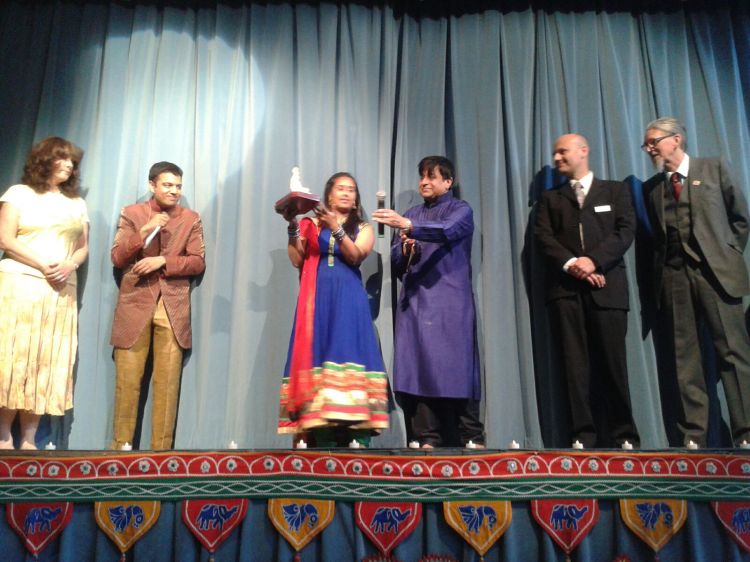
All the London Jain organizations celebrated Lord Mahaveer’s Birthday on Sunday 1st May 2016 in Harrow, where there were around 750 people present.  There Mahaveer Awards were presented by Nitin Mehta to two outstanding individuals. On behalf of The League Against Cruel Sports Darryl Cunnington and  Roger Swaine were monitoring an illegal fox hunt when they were brutally attacked. Darryl suffered a cracked vertebra in the neck and was hospitalized.  Roger also sustained injuries. The awards were given away by Dr. Mukul Shah and Dr. Freya Shah as well as Anubhai and Taraben Shah.

The citations on the awards are as follows:

MAHAVEER AWARD
            
Presented to Darryl Cunnington

You were brutally attacked while monitoring a fox hunt in Leicestershire. Your courage and compassion for defenceless animals is exemplary.  We call your kind act ‘ Abhay Daan’. It means giving someone protection from fear of death. Generations to come will be inspired by you. We salute you.
                                                                                       
Y.I.V. 
1/1/2016.     

MAHAVEER AWARD

Presented to Roger Swain

You were brutally attacked while monitoring a fox hunt in Leicestershire. Your courage and compassion for defenceless animals is exemplary. We call your kind act ‘ Abhay Daan’. It means giving someone protection from fear of death. Generations to come will be inspired by you. We salute you.
                                                                                       
Y.I.V. 
1/1/2016. 

In the picture from left: Barbara Gardner from The Animal Interfaith Alliance, Dr. Mukul Shah, Dr. Freya Shah, Nitin Mehta, Roger Swaine, Darryl Cunnington.

Virtual Reality Safaris – The End of Traditional Zoos

3D Zoos


Illustrator: Joe Evans.  Copyright Ketan Varia/Animal Interfaith Alliance

By Ketan Varia

“I was once in a Safari Park in Kenya in 2005 with my family and saw a lioness as she lay in the grass. Shortly after, she started walking in an elegant and carefree way, towards her family, I suspect (it was early evening).

“A year or so later, I took my family to an animal safari park in Milton Keynes.  The lions there were beautiful, but something was different.   In Kenya, I felt a sense of awe for the lioness.  She made it clear that it was her territory and we were the visitors.  During the safari park visit, the pride of lions we saw looked well fed, but we knew that they were in an enclosure and had adapted to life in an ‘open prison’.  Although I cannot claim they felt miserable, they certainly weren’t free”.

Over 10,0001 zoos exist worldwide, with an estimated holding of about a million vertebrate animals. This seems to provide some benefit for the 7002 million visits the zoos receive from people who come to see them to appreciate the diversity of this earth.  However, what is the cost of this to the animals?  Are we seeing them in their real environment or are we seeing just a shadow of their glory?

Zoos are Outdated

Zoos and animal parks are outdated ways to see animals in the 21st Century.  We now have the technology to provide an experience that both allows us to see animals in their natural habitat and make their experience convincing and ‘real’ and at an affordable price.  Zoo owners will argue that the visits pay for conservation. But we need to build a better virtuous circle.  Conservation should be done within the local environment, except in exceptional circumstances. If you had an illness and needed support, would it not be better to be treated locally than in a hospital ‘cell’ thousands of miles away from your habitat?

What would the Mechanism be for a Virtual Reality Safari?

Using hidden cameras in the wild, in remote locations, we can project their views onto 3D environments locally in the western world.  We would see animals in their natural habitat and be able to see what the wildlife experts saw.  The 3D real-time effect could also involve surprise elements, which would make the experience vivid and engaging.

We could have Safari ‘drives’ with trains or cars driving on a mini ‘track’ adjacent to the 3D screens/projection, so you could see in full perspective – as if you were really there.  The main cameras would be by lakes and rivers, where animals go frequently for nourishment.  It would be possible to have cameras on high wires, hidden between trees, so that they could move in sync with the person creating a real 3D effect, giving a real sense of being in that environment

Technology for a 3D Virtual Reality Safari

The Technology for 3D and entertainment is well established and can come from three main sources:

Firstly, from theme parks that understand how to create an engaging experience. Secondly, from 3D films which are now rendered to make films come alive.  Thirdly, from filming animals/nature in the wild, such as the wonderful nature programmes we have seen from the BBC and National Geographic.  The idea of insitu cameras is nothing new, with BBC’s programmes like “Winterwatch” already established.

Once this concept takes off, there would need to be controls in place to limit the interference to the animals’ environment and lives, and limit the wildlife areas being used to this end.

Conclusion

We don’t need zoos that trap animals, but virtual reality Safaris that utilise technology for a cruelty free experience of seeing animals in their natural habitats. This will create a virtuous circle of conservation which is more sustainable.

Ketan Varia, Director of the Animal Interfaith Alliance.  Editorial support by Jayni Gudka.

  1. Warwick Frost, “Zoos and Tourism: Conservation, Education, Entertainment?”.16 Dec 2010. Print
  2. “The world zoo and aquarium conservation strategy”, World Zoo and Aquarium Association (WAZA). 2015. Web.


Rescued Circus Elephant ‘Rhea’ Reunited with her Long Lost Sisters

Rhea coming out of the truck

(New Delhi, Chennai, Mathura, India – 22nd April 2016).  After performing side-by-side in the circus for more than five decades, circus elephant Rhea is reunited with her companions Mia and Sita, following her rescue by UK based charity Wildlife SOS. For more than five decades, elephants Mia, Sita and Rhea performed tricks together in a circus, and subjected to training and the usual brutal treatment that captive performing elephants are subjected to as part of their indoctrination and obedience training. In November 2015, British charity Wildlife SOS rescued Mia and Sita from their painful lives, but some paperwork required to rescue Rhea was yet to be obtained from the authorities which meant she had to be left behind and could not be rescued along with Sita and Mia.

Geeta Seshamani, Co-founder of Wildlife SOS said, “Elephants are highly intelligent, sentient beings, and form extremely strong bonds with others of their kind. Although Mia, Sita and Rhea were not related by blood, in every other way, they were each other’s family, so it was heart wrenching to have to leave one of these three girls behind, and we had to ensure we returned for her as soon as possible”.

Following months of tireless effort, follow up on paper work, and a five day long commute from Tamil Nadu to Mathura across nearly 2800 km, Rhea elephant has finally been reunited with her sisters Sita and Mia at the Elephant Conservation and Care Centre, run by Wildlife SOS in Mathura, making her the eleventh circus elephant to be rescued by the organization. The excited anticipation was evident amongst the Wildlife SOS staff and rescue team as the Elephant Ambulance convoy transporting Rhea drove into the Elephant Conservation and Care Centre, and everyone watched the reunion of the three elephants with bated breath. 

The female elephants, aged between 45 and 53 years, had obviously missed each other terribly, and began greeting each other with gentle squeaking and rumbling sounds even before they were within each other’s reach, after which they entwined their trunks and patted each other comfortingly, as if reassuring themselves that they were finally together again, and this time in a pain-free, safe place!

The rescue facility, run by Wildlife SOS a registered charity in UK with operations in India is currently home to 19 elephants, all of which have been rescued from situations of abuse as working and performing elephants.

Kartick Satyanarayan, Co-founder of Wildlife SOS, said, “It was fantastic to witness natural elephant behavior and hear the vocalizations of the elephants as they greeted each other. Amidst the squeals of excitement and trunk holding that ensued, we could not help but feel honored to have been part of this reunion. It was overwhelming that we had brought these gentle giants back together as a family”.

Ms. Tamarisk Grummit from Wildlife SOS UK, said, “Rhea has been through so much hardship during her life in the circus and was in dire need of our help to give her a chance at recovery. It was a delight to see her so happy and peaceful with her sisters at her new home in Mathura”.

About Wildlife SOS: A Non-Profit Organization, Wildlife SOS is one of the largest rescue & conservation charities in South Asia. They operate ten wildlife rehabilitation facilities across India, including the world’s largest Sloth Bear Rescue Center and the recently established Elephant Conservation and Care Center that currently houses 22 rescued elephants. Wildlife SOS runs tribal rehabilitation projects that aim to create alternative livelihoods for poachers and other indigenous communities that used to exploit wildlife for livelihoods. Additionally, they run a leopard rescue center, a Wildlife Hotline in New Delhi and ‘Forest Watch’ which is an anti-poaching wildlife crime enforcement unit.


Symposium – Wycliffe Hall, Oxford

Open Discussion Meetings:
 
Thursday 21st April 5:30 pm — ‘Mummy’s got to save the planet’ Marchioness Tracy Worcester 
AND 
‘The God of ALL Creation’ The Rev’d Prof Martin Henig 
 
Wednesday 27th April 5:30 pm — ‘What is Consciousness?’ Dr Rowan Williams  
 
Thursday 28th April 5:30 pm — Book Launch: ‘Thinking Biblically about Islam’ Dr Ida Glaser  
 
Thursday 5th May 5:30 pm — ‘Faith in Business’ Joelle Warren 
 
Thursday 12th May 5:30 pm — ‘Quick Build: Flat-Pack House in 30 days’ Audley English (Architect)
 
Thursday 19th May 5:30 pm — TBC ‘Christ through Jewish eyes’ Rabbi Mark Solomon 
 
Thursday 26th May 5:30 pm — ‘Then Sings My Soul’ Philip Percival 
 
Thursday 2nd June 5:30 pm — Book Launch: ‘Revelation Unpacked’ Leslie Marsh (Historian and Theologian)
 
Thursday 9th June 5:30 pm — ‘Peace and De-Radicalisation’ 
Panel: Prof Eileen Barker OBE
AND
Rupert Shortt (TLS)
 Chaired by a senior member of the University of Oxford
FREE of Charge – Booking NOT Required – ALL Welcome
Please note that all meetings will start at 5:30 pm and there will be Wine Reception
Venue: 
Wycliffe Hall, University of Oxford, 54 Banbury Road, Oxford, OX2 6PW
Parking
 
Venue Parking: There is very limited availability.
FREE Street Parking  is available within walking distance on streets off Banbury Road or Woodstock Road. 
 
Pay & Display Parking is also available on streets behind the venue.
 
Bus
 
There are a number of bus routes passing the venue. 
 
For any information please email Shahriar: shroxford@gmail.com
 

A Friendly Disclaimer:  The views and opinions expressed by the speakers in the spoken or written content of their individual presentations do not necessarily

reflect the views of the organisers of Open Discussion Series.

Look forward to seeing you again in the meetings.
Good wishes,
Shahriar