AIA is partnering with Peace Advocacy Network and the Interfaith Vegan Coalition (IVC)to explore the ethical aspects of veganism from different religious perspectives in a series of webinars.
The third webinar will be held on Monday 18th November at 10.00am PT, 6.00pm GMT and will explore veganism from Sikh, Muslim, Jewish and Hindu perspectives.
COP29 is being held from 11 – 22 November 2024 in Baku, Azerbaijan, where the Global Faith Leader Summit, led by UNEP’s Faith for Earth Coalition, will be taking place in the Faith Pavilion, hosting a range of activities and events by the faith network.
Full details of the Faith Pavilion at COP29 can be seen here.
“We have an ethical and moral responsibility to support laws, policies, and government actions that will achieve the goals of the Paris Agreement”, says Dr. Iyad Abumoghli, Founder & Director of the Faith for Earth Coalition (UNEP).
AIA is a member of the Faith for Earth Coalition and a UNEP accredited organisation.
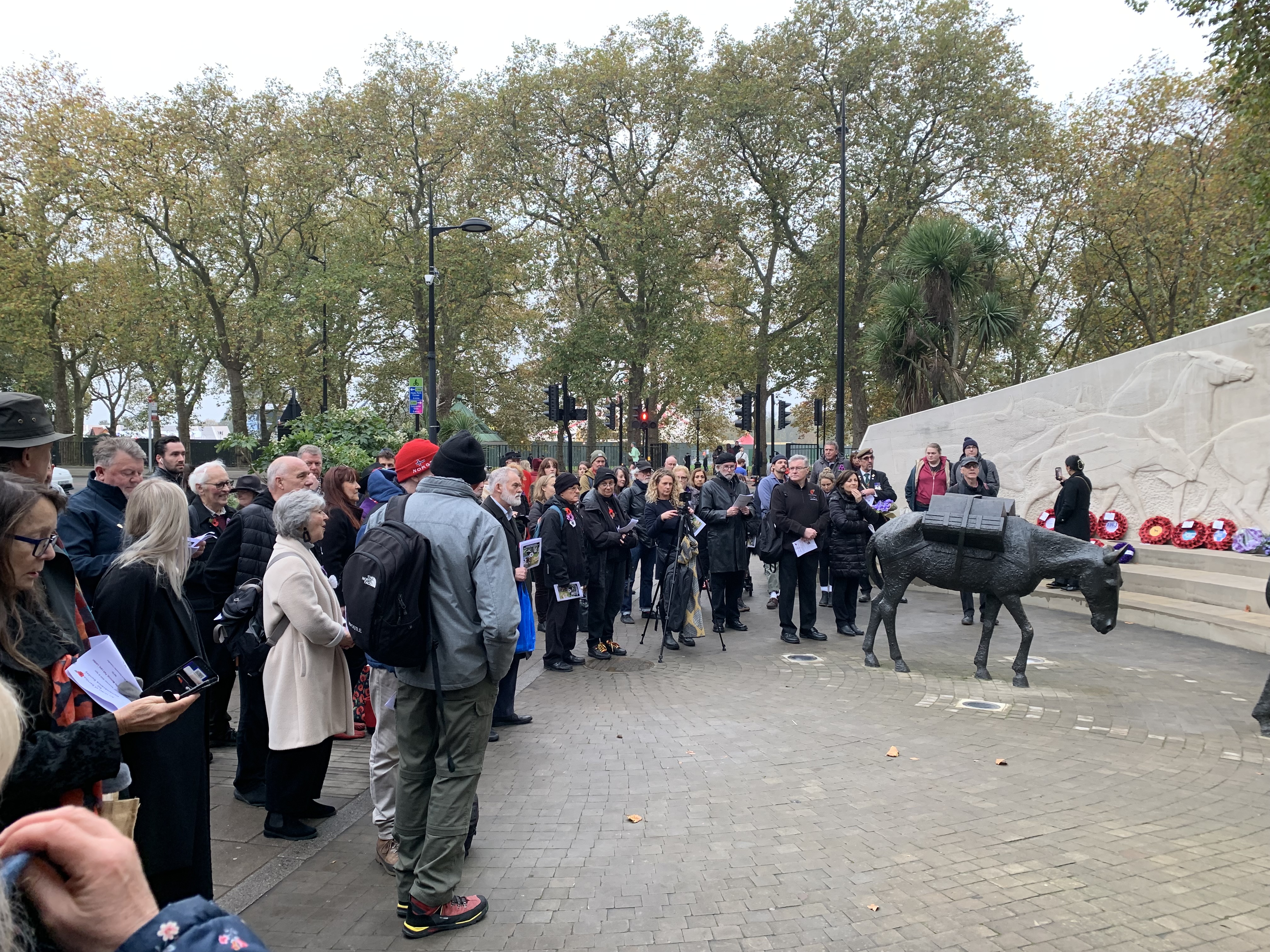
Many gathered for the ASWA Animals in War Memorial Service, held at the Animals in War Memorial, Park Lane, London on Remembrance Sunday, 10th November 2024, to remember all the animals and people who gave the ultimate sacrifice in wars past and present.
The service was led by Rev. Samantha Chandler, Secretary of the Anglican Society for the Welfare of Animals (ASWA), with a “A Time to Reflect’ presented by David Hill of Nowzad who are helping animals in Afghanistan and Ukraine. A poem was written and read by Janet Wilkes and the Intercessions were read by AIA’s Barbara Gardner.
Join us on Zoom as Dr Nayana Shah describes how faiths are shaping our common future at the Parliament of the World’s Religions (PoWR).
Dr Nayana Shah is a trustee of the Parliament of the World’s Religions, a patron of the Animal Interfaith Alliance and a theoretical quantum physicist. She will be talking about the role of the Parliament in promoting global interfaith harmony and shaping our common future.
All are welcome to the talk which will be followed by a Q&A session.
To register for the zoom link, please email Barbara at barbgard.aia@gmail.com.
Presentation by Dr Andre Menache, AIA Chair and Scientific Consultant at Antidote Europeto the 6th annual meeting of the European Veterinary College of Behavioural Medicine and Animal Welfare in Paris on 3rd October 2024
The regulatory requirement that all new pharmaceutical drugs be tested on animals before proceeding to clinical trials can be traced back to the Doctors’ Trial in Nuremberg at the end of the Second World War (Greek, 2012). Subsequent recommendations and directives, including the Helsinki Declaration (World Medical Association weblink) relevant EU Directives (European Medicines Agency weblink) and the International Conference on Harmonisation continue to rely on the Nuremberg Codes with respect to animal use and regulatory toxicology (Ohno, 2002). However, it would appear that the laws have not kept up with scientific progress. As an example, human organ on a chip technology is now widely available and increasingly used by the pharmaceutical industry for the purposes of evaluating drug safety in preclinical screening. While ‘human on a chip’ technology is still under development, the human liver on a chip is probably the most significant innovation currently being used by industry and could be considered to have achieved ‘validation’ status based on a weight of evidence approach (Ewart, 2022). It is far more predictive than animal testing in terms of correctly identifying drug induced liver injury (DILI). As DILI is the leading cause of withdrawal of approved drugs from the market (Levner, 2023), it makes sense that the liver on a chip should be included in all new drug applications (NDA) as a matter of urgency and that the results obtained from animal tests be submitted to the relevant regulatory agencies and compared with the results obtained from the liver on a chip.
Ewart, L. Apostolou, A. Briggs, S. et al. (2022) « Performance assessment and economic analysis of a human Liver-Chip for predictive toxicology », Nature Communications Medicine 2 : 154.
Greek, R. Pippus, A. Hansen, L. (2012) « The Nuremberg Code subverts human health and safety by requiring animal modelling », BMC Med Ethics Jul 8:13:16.
Levner, D. and Ewart, L. (2023) « Integrating Liver-Chip data into pharmaceutical decision-making processes », EXPERT OPINION ON DRUG DISCOVERY, 18 :2 :1313-1320.
Ohno, Y. (2002) « ICH guidelines–implementation of the 3Rs (refinement, reduction, and replacement): incorporating best scientific practices into the regulatory process », ILAR J 43 Suppl:S95-8.
WMA DECLARATION OF HELSINKI – ETHICAL PRINCIPLES FOR MEDICAL RESEARCH INVOLVING HUMAN SUBJECTS.
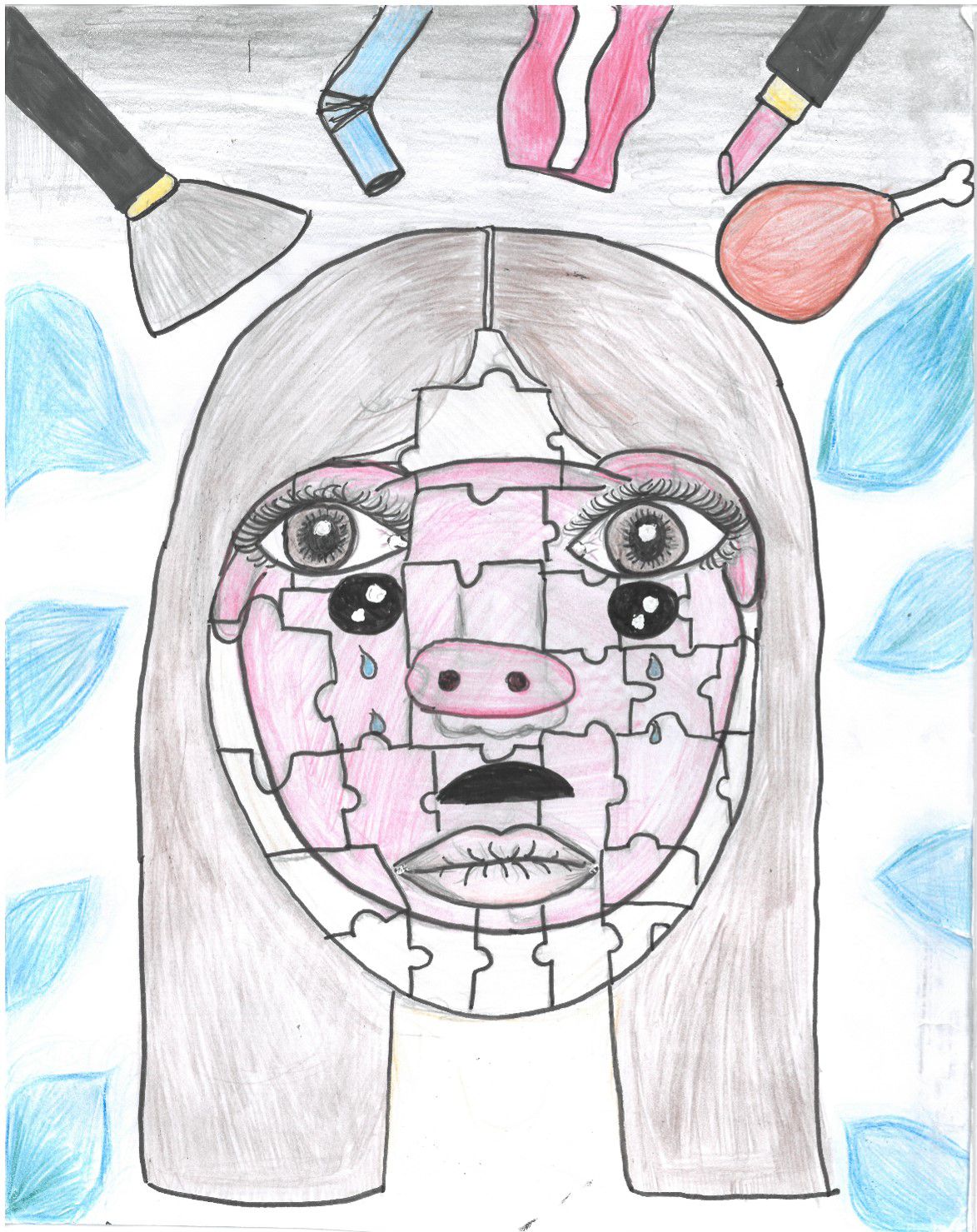
‘Ethical Dilemma’ by Sian Hughes, age 13, joint winner of the 12-13 age group.
This year’s entries to the NATRE international Spirited Arts competition on the theme “Why Do Animals Matter?” were truly spectacular! It is the second year that Animal Interfaith Alliance (AIA) and Veganism in Education (VinE) have sponsored a theme that enables children and young people to explore human-animal relations and to think deeply about the moral and spiritual aspects of all living beings. Once again, we were blown away by the children’s extraordinary artistic creations and deeply reflective narratives. Each piece not only showcased remarkable talent but also conveyed profound insights into the significance of animals in our lives, offering thought-provoking perspectives on empathy and compassion through the unique lens of religious education.
This year’s judging held an extra special touch, as the founders of AIA and VinE travelled alongside our President, the esteemed academic Dr Richard Ryder, to RE Today’s headquarters in Birmingham. There, we had the pleasure of meeting the wonderful RE Today team and Angela Hill, the visionary behind RE Today’s pioneering resources on ethical veganism as a worldview. These resources were commissioned by VinE with input from AIA and have been freely available to teachers and schools since January 2023. Angela’s work inspired the animal theme and supported school engagement, enriching the children’s interpretations and bringing thoughtful, compassionate approaches to their artwork.
Selecting winners from thousands of entries proved immensely challenging, as each submission showcased exceptional creativity and insight worthy of recognition. We are especially grateful to our President, Dr Richard Ryder, for undertaking the difficult task of selecting the theme’s winners and runners-up.
Dr Ryder said: “I have very much enjoyed helping in the judging of the Spirited Arts competition, and I thought the children showed high levels of creativity and concern for the animals. I am proud also as AIA’s and VinE’s President that so many children showed a clear ethical concern.
“I believe, as a psychologist, that most children are concerned and interested in members of other species. This is not just a children’s interest, but one that can and should last throughout life. In my childhood, however, adults too often tried to stop this interest as being “sissy”. Far from it: such interests and compassion are the foundation for a moral community of all painient beings”.
A heartfelt thank you to everyone involved – teachers, students, NATRE and the RE Today team – for making this year’s theme a resounding success! We can’t wait to judge the entries to next year’s animal theme!
The results of the 2024 Spirited Arts Competition ‘Why Do Animals Matter?’ will be announced on World Vegan Day – 1st November 2024.
Since RE Today, Veganism in Education and AIA launched their ground-breaking new school resourcesfor veganism in religious education back in January 2023, we have run Spirited Arts competitions in both 2023 and 2024. Schools across England & Wales and beyond have taken part in the competitions, producing some most creative and inspiring work.
We aim to announce the winners and the runners up of the 2024 competition ‘Why Do Animals Matter?’ on World Vegan Day – 1st November.
The gallery of the winners and runners up for last year’s theme (2023) ‘All God’s Creatures?’ can be viewed on the Veganism in Education website here.
The Religious Education Resources In January 2023, the first range of freeclassroom resources for Religious Education, which enable teachers and pupils to explore, through critical, objective and pluralistic RE lessons, questions around the moral status of animals and ethical veganism as a worldview, were launched. Veganism in Education (VinE) had commissioned RE Today to produce these excellent resources with input and support from the Animal Interfaith Alliance.
Further details, along with an introduction by our wonderful patron, Peter Egan, can be viewed here.
Luv4all Uganda (loveforalluganda.org) is a vegan organisation dedicated to promoting effective altruism and fostering a culture of empathy, kindness, and understanding for all sentient beings. Their mission is carried out through education, advocacy, and community engagement, while developing a sustainable food system that aligns with their values by providing plant-based alternatives to animal products.
In 2022, they founded the Atlas Vegan Community School, Uganda’s very first vegan school. It serves 200 children, offering daycare for ages 2 and nursery and primary education for ages 3 to 12.
Congratulations to Duncan McNair, founder of Save The Asian Elephants (STAE) and instigator of the Animals (Low Activities Abroad) Act, who was awarded “Legal Hero of the Year 2024” by the Law Society in an important ceremony in London on 12 September 2024.
There were 19 shortlisted nominees drawn from 500 plus entries out of 220,000 solicitors, and five eventual winners.
Duncan said “I was pleased today to be awarded ‘Legal Hero of the Year 2024’ by the Law Society. But it’s all about the animals we love and are so concerned for and I hope it will help raise awareness to encourage the implementation of the new Act and its adoption across the world”.
Exclusive Interview with AIA
Duncan McNair of Save The Asian Elephants gave an exclusive interview to AIA on The Animals (Low-Welfare Activities Abroad) Act 2023.
Can you please introduce yourself to our readers and explain the mission of Save The Asian Elephants?
I’m Duncan McNair, a lawyer practising litigation in the City of London. I always wanted to be involved in major animal protection causes since youth. It was one reason why I pursued a path to being a lawyer. There have been several very senior judges in my family but I wanted to practise law, to have clients, to gather evidence, to present and try to win cases, above all to help and protect vulnerable animals, who have no voice we can understand.
I founded Save The Asian Elephants in 2015 after my first visit to India, where I was utterly traumatised and outraged to see endangered baby elephants beaten and stabbed, screaming and crying, to “break” them for easy use in tourism – much generated in the UK. The mission was to help preserve and protect the ancient, wondrous species of Asian elephants, whose numbers have crashed spectacularly almost to no return. The aim was new law to end the advertising and sale of unethical animal tourism practices, including amongst hundreds of practices, elephant riding (which involves prior extreme brutality).
I felt sure we had to approach the problem from the right angle, and resolutely; to develop measures whose success is not contingent on the concurrence of the countries where the brutality is happening; to develop a powerful and persuasive evidence base, formulate coherent and credible, consistent policies, hugely raise public awareness, to gain and maintain vast support, and then lean hard on the political classes – to change the law and make sure it really works. No more empty blandishments from unethical travel companies about change – we needed compulsion of law, widely publicised and robustly enforced.
2. Can you please explain what “low-welfare” activities are and how tourism related to these activities affects animals?
Difficult to define “low welfare” as it embraces endless different brutal and unethical practices towards animals. Any activity that limits or prevents the “Five Freedoms” – freedom from hunger and thirst, from discomfort, from pain, injury, disease, from fear and distress, to express normal behaviour. In practice, “low welfare” is a mild expression of the most extreme violence and damage done to many species, wanton, pointless, driven by the commercial imperative. Exploitative tourism treats highly sentient creatures as if they are inanimate and incapable of feelings. The unregulated, often reckless and ruthless global market often forgets this in the stampede for turnover and profit.
3.Is there a particular animal you think of when you think about low-welfare animal activities? Can you tell us their story?
Numerous species across every corner of the world will benefit from this Act. Take Asian elephants – complex, majestic and ecologically crucial “mega-gardeners of the forests” which they nourish and sustain. Their sad fate in tourism is to be snatched as babies from the wild, their defensive mothers killed in front of them, isolated and starved for weeks, then beaten, ripped with hooks and screamed at until their “spirits break” (called Pajan). One half die in the process. Their remaining lives are endured often in extreme violence, deprivation and despair.
Add to the list baby monkeys enslaved from the forests to a life of selfies and profile pics, tiger cubs just photo props then drugged and chained for life in tiny cages, “walking with lions” later sold on for “canned hunting”, dolphins and orcas in tiny featureless pools till death, ostriches seriously injured and in great pain by being ridden – all these and more will gain from this law whose ultimate goal is to steer the market towards ethical tourism.
4.How do the wild animal photo-op industries feed into poaching/canned hunting?
Its yet another form of unthinking commercial exploitation of defenceless animals, by some of the world’s biggest businesses. They generate a pseudo-myth that its Manly and courageous to take on a wild creature. But they’re not wild, they’re drugged, declawed, vaseline spread in their eyes, helpless, and it’s all completely uneven. The animals with whom tourists are coaxed to have selfies, play games and tricks or even to kill when cowering in a cage – for tourism fun and kicks – have no chance at all, no life, no dignity, no mercy. Its cowardly but it plays to Man’s ego and vanity, especially if they can then adorn their fireplace back home with the head or pelt of the victim.
5.Can you please tell us about the Animals (Low-Welfare Activities Abroad) Act and what the Act’s current status is?
The Act prohibits travel companies from selling or advertising in this country attractions or activities abroad which inflict low standards of welfare on any vertebrate animals if those activities would be unlawful if taking place in England and N Ireland. We hope that Scotland and Wales will soon enact similar legislation and we are working for that now. It is already law but it needs “activity regulations” to be introduced – a long list of abusive activities that must no longer be promoted. STAE has sent these to government along with comprehensive evidence in support.
The Act is hugely important because it’s measures can be adopted by any country in the world where markets in unscrupulous animal-tourism flourish. This includes continental Europe, USA, Australasia and almost everywhere else.
Please help Save The Asian Elephants (STAE) as we lead a huge coalition of charities in getting the Westminster government to implement these measures.






 Animal Interfaith Alliance