TROPHY HUNTING: WHAT THE EVIDENCE SAYS

By Dr Christina Nellist – Pan-Orthodox Concern for Animals

EVERY YEAR, TENS OF THOUSANDS OF WILD ANIMALS ARE KILLED BY TROPHY HUNTERS AROUND THE WORLD.

Threatened and internationally protected species, such as elephants, rhinos, lions, leopards, and bears, are amongst the most coveted targets.

Trophy hunting of threatened and internationally protected species, as well as the shipping of trophies to the hunter’s country of origin, is legal across many countries. While the US and EU are the largest importers, significant number of trophies are imported to the UK each year, including from threatened species.

There is evidence that trophy hunting is often unsustainable and can threaten the stability of populations and the survival of species, while also frequently failing to deliver claimed benefits for wildlife and local communities.

In response to repeated government commitments to ban hunting trophy imports into the UK, the trophy hunting industry is again actively lobbying policymakers and promoting arguments in favour of trophy hunting that does not stand up to scrutiny.

Trophy hunters pay to hunt and kill rare and threatened species.

The willingness to pay to kill a ‘trophy’ animal and retrieve body parts for display distinguishes trophy hunting from subsistence hunting or population management activities. Iconic and rare species are the most coveted targets.

Trophy hunters may pay very large sums to kill specific ‘target’ animals to obtain all or part of their remains, such as heads, tusk, horns, or skins, as trophies. Typically, the rarer the species, the more prized the trophy, increasing its symbolic and market value and making it more lucrative for hunting businesses. Although hunting packages often include several ‘lesser value’ target animals, such as antelopes or baboons, the industry is incentivised to encourage hunters to target threatened and protected species, such as elephants, lions, rhinos and leopards in Africa, brown bears in Europe, and polar bars in Canada.

Trophy hunting contributes to the decline of protected animals and undermines global conservation efforts.

Trophy hunting increases pressure on species that may already be negatively affected by habitat loss, wildlife trade and trafficking, climate change and other threats. It can also impact the genetic makeup of populations, disturb the dynamics of natural selection, and cause intense and avoidable animal suffering.

Many wildlife populations subject to trophy hunting are already in serious decline. Trophy hunting quotas are often set to maximise profits and are not based on scientific data, adding to the pressure on targeted species. Trophy hunters also typically target the animals that make the best trophies. These are often the largest and most impressive individuals who play key roles in their social groups and whose genetic heritage is important for the species’ future survival. Their removal is contrary to the dynamics of natural selection, weakens the gene pool, induces phenotypic (physical) changes, impacts reproduction and social behaviours, and may increase the likelihood of conflict with humans.

Trophy hunting fails to deliver claimed benefits for wildlife and communities.

Revenues from trophy hunting are typically too small to provide an effective and sustainable incentive for local communities to protect biodiversity, to prevent poaching, or to reduce human-wildlife conflict. The main beneficiaries of trophy hunting are governments, (mostly foreign) hunting tour operators, private landowners, and local elites. The proportion of revenue derived from trophy hunting that reaches local communities, or is used for conservation purposes, is, in many cases, very small. Trophy hunting typically maintains local people in a cycle of dependence, and can prevent the development of sustainable alternatives, such as ecotourism, which as the potential to provide more and better jobs and benefits for communities.

The legal trade in trophies facilitates the laundering of animal parts.

The legal trophy trade can stimulate demand for animal parts and provide opportunities for traffickers, fuelling corruption. The targeting of threatened and protected species for their body parts by trophy hunters can undermine global trade bans and efforts to curb poaching and trafficking, by providing opportunities for criminals to launder illegal wildlife products into trade. The use of hunting permits to facilitate the lucrative illegal trade in rhinoceros’ horn in Africa, Asia and Europe has been well documents. The activities of criminal networks and syndicates pose risks to security, livelihoods, social stability, local economies, and the rule of law.

An overwhelming majority of UK citizens oppose trophy hunting and support a ban on trophy imports.

Current UK legislation allows the import and export of hunting trophies from species that are otherwise protected under UK and international law and are not allowed to be traded under other circumstances due to concern for their conservation status.

A significant  majority of UK citizens surveyed oppose trophy hunting and support a ban on trophy imports. Acknowledging this growing societal opposition, successive UK government shave committed to introduce measures to ban or restrict hunting trophy imports, while several major players in the transportation sector have committed to cease transporting hunting trophies. The Labour Party’s 2023 election manifest included a commitment to ban the import of hunting trophies.

RECOMMENDATIONS

We call on the UK government to ban the import and export of hunting trophies to and from the UK.

A ban on the import and export of trophies is crucial to reduce the pressure on biodiversity, prevent avoidable animal suffering, and encourage alternative income streams for local communities in countries where trophy hunting takes place. It would also bring the UK into line with the increasing number of European countries taking action.

POCA, along with other groups such as Born Free, Four Paws and Humane World for Animals, who organised this week’s events in Parliament, have long advocated for the end of ‘sport’ or ‘recreational’ hunting and campaigned with others for the ban on the importation of so-called ‘trophies’.

Left – Dr Christina Nellist, President of Pan Orthodox Concern for Animals Charity, and Board Member of the Animal Interfaith Alliance (AIA).

Middle – Baroness Hayman of Ullock, Parliamentary Under-Secretary of State at the Department for Environment, Food and Rural Affairs (DEFRA), and Minister for Animal Welfare in the House of Lords.

Right – Chris Fegan, Chief Executive at Catholic Concern for Animals and Deputy Chair of AIA.

Last time a bill on this came before Parliament, we had cross-party agreement to make it happen and we were also there at that time:

Dr Nellist (POCA) with Peter Egan, Actor and Animal Activist.

Dr Nellist (POCA;AIA), Eduardo Gonzales (Journalist; Animal Campaigner) ; Judith Wilson (AIA)

Unfortunately, a few terrible  men used an old parliamentary technique called Filibustering ( a political procedure in which one or more members of a legislative body prolong debate on proposed legislation so as to delay or entirely prevent a decision.) This obstruction prevented the last attempt to ban the importation of trophies from becoming law.

This time we must ensure this does not happen #GetTheBanDone.


CCA Statement on the Passing of Pope Francis

It is with profound sorrow that Catholic Concern for Animals (CCA) has learnt of the passing of Pope Francis. As a Catholic charity, we mourn the loss of an enlightened and inspiring leader who guided the Church with love and compassion for all of God’s creatures. His ground-breaking Encyclical Laudato Si’ has been the bedrock of CCA’s work since its publication in 2015. The Encyclical’s rejection of despotic anthropocentrism, and its exhortation to hear the cries of the suffering and to cultivate an ethos of care for all creation are more relevant than ever in the turmoil of today’s world. Confident that Pope Francis is now resting in God’s arms, we are immensely grateful for his gift. He will be sorely missed but his legacy will continue to shine a light on our path as we pursue CCA’s charitable mission to advance Christian respect and responsibility for the animal creation within the Catholic tradition.

21 April 2025


London Underground Billboard Campaign to Replace Animal Testing with 21st Technology

Screenshot

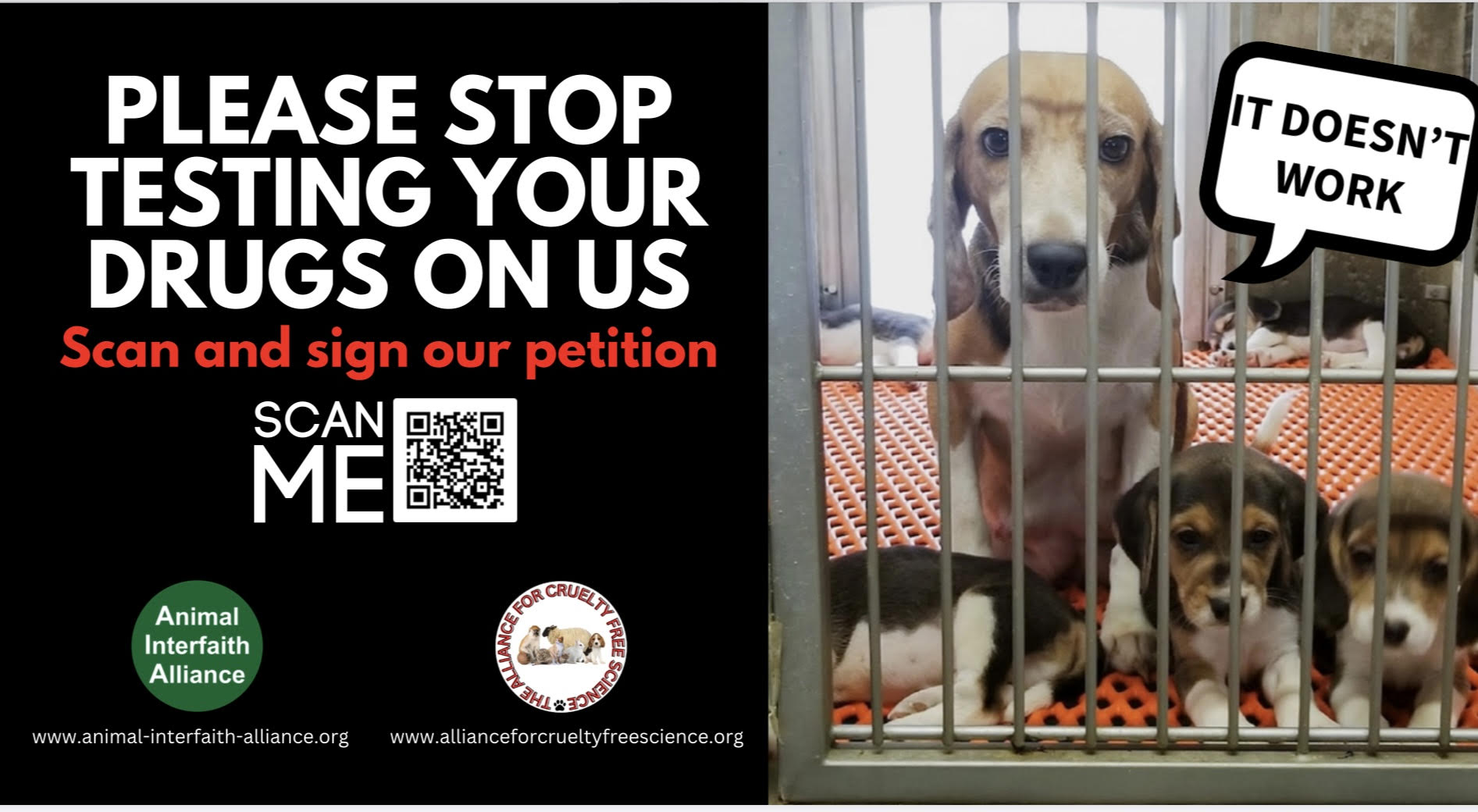
The Alliance for Cruelty Free Science and the Animal Interfaith Alliance have worked collaboratively on a Government petition to replace animal testing with 21st century technology and to design and promote a London billboard and tube platform campaign which launches on Monday 10th March 2025.

The campaign is designed to support the Government petition “Ban animal testing for human products and medicines” which requires the Government to debate the issue of replacing animal tests with 21st century technologies which are more reliable, safer for humans and don’t require animal suffering. The petition is promoting the case that animal testing would not be used for new drugs, and other scientific methods would be used instead.

Please sign the petition

The central focus is a 48 sheet poster in Piccadilly Circus Tube station specifically aimed at capturing the attention of the public and shareholders in the pharmaceutical industry. This is closely supported by a widespread billboard campaign across London. A huge illuminated message aimed at the general public who, once made aware, are scandalised by the waste and welfare of research animals especially when using taxpayer funds in a testing methodology that fails 9 out of 10 times in human medicines and drugs.

We are most grateful to the Alliance for Cruelty Free Science for all their work on this project and to our key AIA member Quaker Concern for Animals (QCA) for their financial support.

The Alliance For Cruelty Free Science brings many animal activism groups together, to help end unnecessary animal suffering within the vivisection industry. They promote cruelty free science, easy cruelty free swaps, expose the vivisection industry, and promote a kinder way.

Contact for Animal Interfaith Alliance – Dr Andre Menache andre.menache@gmail.com

Contact for the Alliance for Cruelty Free Science – Linda Birr-Pixton
hello@allianceforcrueltyfreescience.org


AIA Backs Replacement of Animal Testing with 21st Century Technology

Screenshot

The Animal Interfaith Alliance is joining with the Alliance for Cruelty Free Science (ACFS) to bring a debate in Parliament to replace outdated animal testing with 21st century technology.

We need to achieve 100,000 signatures on our Government petition in order for there to be a Government debate on the subject. We are joining the ACFS in backing a poster campaign in the London Underground to raise awareness of the petition. The QR code on the poster takes you to the Government petition.

Whilst the title of the Government petition is “Ban animal testing for human products and medicines” our message has always been to “Replace animal testing with 21st century technology” which is the title of AIA’s own Change.org petition which we hope to hand in to No. 10 Downing Street.

The title of the Government petition was altered by the Petitions Committee. It has never been AIA’s message to ban animal testing on human medicines without offering an alternative, and we believe that there are now 21st century technologies that provide better alternatives to outdated animal testing. These are detailed on our website here.

Please sign and share both of our petitions.


Inaugural Meeting of UNEP’s Interfaith Women Council

UNEP Executive Director, Inger Andersen introduces the Interfaith Women Council

UNEP’s Faith for Earth Coalition held the inaugural meeting of it’s Faith for Earth’s ‘Interfaith Women Council’ on Thursday 30th January 2025.

The Faith for Earth Interfaith Women Council is a platform composed of distinguished faith and interfaith influential women leaders advocating for environmental stewardship and sustainable development through their communities, inspired by their spiritual traditions. 

The Inaugural meeting was chaired by Faith for Earth Director, Dr Iyad Abumoghli and an address was given by UNEP’s Executive Director and UN Under Secretary, Inger Andersen. Each of the new Council Members then gave a three minute presentation about projects they were working on. AIA’s Barbara Gardner MBE gave the following presentation which focused the Nexus between Animal Welfare and the Environment.

Address to UNEP’s Interfaith Women Council

Inaugural Meeting – Thursday 30 January 2025

Barbara Gardner – Founder of the Animal Interfaith Alliance – a unique alliance of the world’s most influential faith-based, animal advocacy organisations which speaks out on the moral treatment of animals by drawing on the combined wisdom of all faiths and worldviews.

A Key Project that we are dealing with is to ensure that the Nexus between Animal Welfare and the Environment is recognised at the United Nations.  Caring for the planet and the environment starts with how we treat the other sentient beings that we share our beautiful planet with.  All faiths recognise and address this, although this is often forgotten in the current practice of our faiths.  It is addressed by both Pope Francis in his Encyclical on the Environment, Laudato Si’ and by its Islamic sibling, Al Mizan.

While we treat animals cruelly and inhumanely, particularly in factory farming systems, we can never protect the environment, as so much environmental damage is caused by animal agriculture, including the destruction of rainforests, oceans and other ecosystems, the pollution of seas, rivers and the atmosphere, and global warming from carbon and methane emissions. So much of our land is taken up to provide food for farmed animals which is wasteful and feeds the rich whilst the poor still remain hungry.

Also, we will never create a fair and just society where women, indigenous people and minorities are properly treated and respected whilst our hearts are hardened by the way we treat other sentient beings, which is often with extreme cruelty and brutality, as happens in the animal agriculture industry.

We are also concerned with how animals are used for testing medicines and other products.  Not only does this include extreme cruelty, it is also a lazy means of product testing which fails humans, as better 21st century technology, which could be used for testing, is ignored.

So, we want to see a resolution on the Nexus between Animal Welfare and the Environment passed at the United Nations, and we want to see Animal Welfare included in the 2030 Sustainable Development Goals.

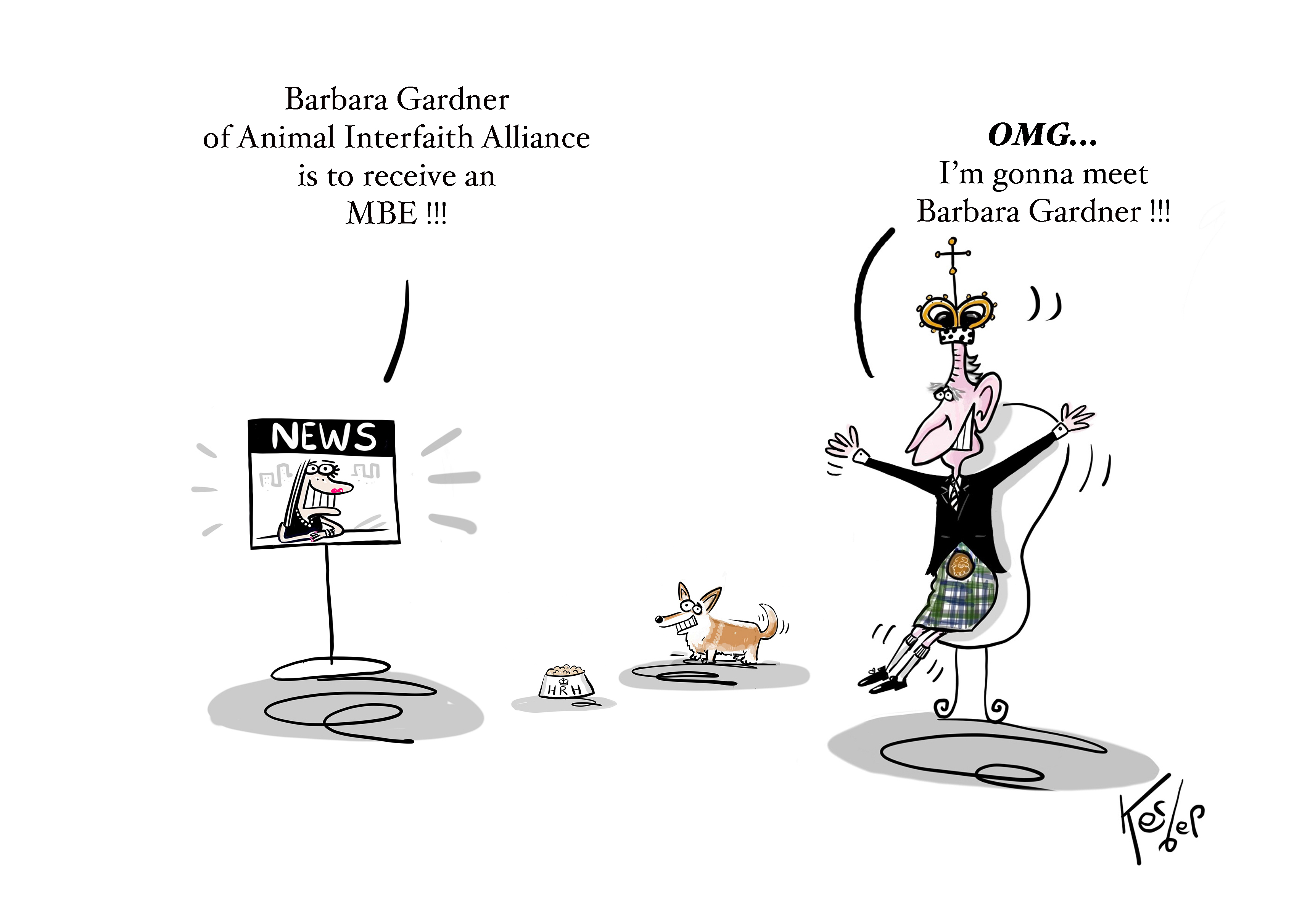
Finally, I have just been awarded an MBE in the King’s New Year Honours list for services to animal welfare, which demonstrates how interfaith work and animal welfare are now being valued by the UK Government and the King.


MBE for AIA in King’s New Year Honours

Cartoon by Neil Kerber, cartoonist for Private Eye

We are delighted to announce that the Animal Interfaith Alliance’s work for animal welfare was recognised by the announcement of an honour for its Founder and CE, Barbara Gardner in the King’s 2025 New Year’s Honours list.

The MBE was for “Founder and Chief Executive Officer, Animal Interfaith Alliance, and Trustee and Treasurer, RSPCA. For services to Animal Welfare”.

Barbara said: “I am delighted that ‘animal welfare’ has been rewarded in the honours system. This is a wonderful recognition of animal welfare and of all the devoted people who work tirelessly to promote it. We must build on this to work for a kinder world for animals”.


Interfaith Vegan Panel Webinar 3

AIA is partnering with Peace Advocacy Network and the Interfaith Vegan Coalition (IVC)to explore the ethical aspects of veganism from different religious perspectives in a series of webinars.

The third webinar was held at the end of Animal Interfaith Week, on Monday 18th November and explored veganism from Sikh, Muslim, Jewish and Hindu perspectives.

The second webinar, held on 23 September 2024, explored Christian, Jain and Jewish perspectives and can be viewed here.

The first webinar, held on 19th August 2024, explored Catholic, Orthodox, Buddhist and Jewish perspectives and can be viewed here.


The Parliament of the World’s Religions: Faiths Shaping our Common Future

Presentation by Dr Nayana Shah
14th November 2024

Can faiths shape our common future and what does that mean for animals? What role does the Parliament of the World’s Religions (PoWR) play in this?

At the AIA AGM, during Animal Interfaith Week 2024, Dr Nayana Shah told us about the work of the PoWR, its esteemed history and future goals.

Dr Shah is a trustee of the PoWR and a patron of AIA, as well as being a theoretical quantum physicist.


AIA Celebrates its 10th Anniversary during Animal Interfaith Week 2024

Image by Gerd Altmann from Pixabay

Founded in 2014, AIA is celebrating its 10 year anniversary by taking a look back at some of its achievements over the past 10 years. Full details are here.

The Celebration takes place during Animal Interfaith Week 2024, full details of which are here. The events included ASWA’s Animals in War Memorial Service in Park Lane, London on Sunday 10th November – Remembrance Day; the online AGM talk ‘The Parliament of the World’s Religions: Faiths Shaping Our Common Future‘ by PowR Trustee and AIA Patron, Dr Nayana Shah on Thursday 14th November; and the third Interfaith Vegan Panel webinar, jointly hosted by AIA and the Peace Advocacy Network, with the Interfaith Vegan Coalition on Monday 18th November.