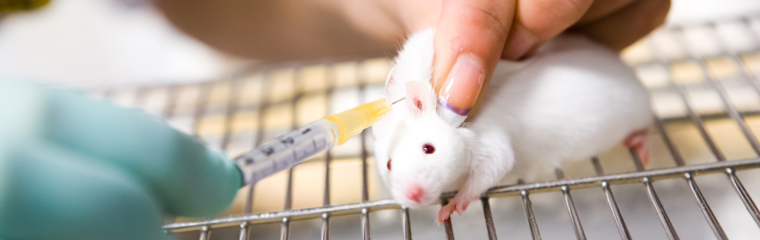
One of our key goals is to campaign to replace the use of animals in laboratory testing with 21st century human relevant test methods. Animal experiments are based on outdated, 75 year old legislation which has not kept up with the advances in modern technology. The only thing preventing pharmaceutical companies from moving to human relevant test methods is a lack of political will to work with the regulatory bodies to update the regulations.
AIA Warmly Welcomes the Government’s New Strategy to Replace Animal Testing with Human-Relevant Test Methods
November 2025
The Animal Interfaith Alliance (AIA) warmly welcomes the Government’s new strategy, “Replacing Animals in Science: A strategy to support the development, validation and uptake of alternative methods” which AIA has been campaigning onsince its inception ten years ago.
The strategy’s vision is “for a world where the use of animals in research and development is eliminated in all but exceptional circumstances, achieved by creating a research and innovation system that replaces animals with alternative methods wherever possible”.
We celebrate the fact that the government has at last recognised that the animal testing model is out-dated and that non-animal research methods are the way forward.
With the recent advancement of human-relevant test methods, the Government recognises the opportunities for replacing animal experiments. It also recognises that it must create the environment to encourage this. The strategy seeks to implement this environment.
The strategy has six objectives:
- Accelerate the replacement of animals in science to phase out their use.
- Achieve equal or better research and testing outcomes using alternative methods.
- Drive private investment in alternative methods to boost innovation and growth.
- Improve regulatory confidence and acceptance of alternative methods.
- Create infrastructure and partnerships to unlock value from UK data.
- Position the UK as a global leader in alternative methods.
The strategy divides animal experiments into three baskets, those where alternatives already exist and can be replaced immediately, with many planned to be phased out by 2026, those where alternatives are being developed, which will take a little longer, and those which currently have no alternatives, but where these should be developed.
AIA has been campaigning to replace animal testing with human-relevant test methods for over ten years, so we are delighted to, at last, see a serious strategy to achieve this. The strategy’s targets for ending animal testing are ambitious. However, we will be vigilant in overseeing the achievement of those targets. Whilst this is a significant step, we must ensure that progress is timely and that specific issues within the Government’s report be examined and worked through. Our scientific expert, Dr Andre Menache has written a review outlining some of the potential issues within the report, which can be read here. Through our political representative and continued consultation and campaigning, we aim to keep the pressure on the government to address the potential problems to ensure genuine and timely progress.
Lobbying the UK Govt to Replace Animal Testing 2025
Peter Egan Interview with Dr Andre Menache on Animal Testing
On 17 May 2025, AIA Chair Dr Andre Menache wrote to Wes Streeting MP, Secretary of State for Health and Social Care, concerning the policies of the Medicines and Healthcare Products Regulatory Agency (MHRA). The letter is reproduced below. A response was received from the MHRA’s Interim Executive Director of Innovation and Compliance, Mr James Pound on 11 June 2025, also reproduced below. Our view is that the MRHA’s response is unsatisfactory. A different approach needs to be found for meaningful change to happen.
Read the full report here.
Government Petition to Replace Animal Testing with 21st Technology and London Underground Billboard Campaign

The Alliance for Cruelty Free Science and the Animal Interfaith Alliance have worked collaboratively on a Government petition to replace animal testing with 21st century technology and to design and promote a London billboard and Tube platform campaign which launches on Monday 10th March 2025.
The campaign is designed to support the Government petition “Ban animal testing for human products and medicines” which requires the Government to debate the issue of replacing animal tests with 21st century technologies which are more reliable, safer for humans and don’t require animal suffering. The petition is promoting the case that animal testing would not be used for new drugs, and other scientific methods would be used instead.
Please sign the petition
The central focus is a 48 sheet poster in Piccadilly Circus Tube station specifically aimed at capturing the attention of the public and shareholders in the pharmaceutical industry. This is closely supported by a widespread billboard campaign across London. A huge illuminated message aimed at the general public who, once made aware, are scandalised by the waste and welfare of research animals especially when using taxpayer funds in a testing methodology that fails 9 out of 10 times in human medicines and drugs.
We are most grateful to the Alliance for Cruelty Free Science for all their work on this project and to our key AIA member Quaker Concern for Animals (QCA) for their financial support.
The Alliance For Cruelty Free Science brings many animal activism groups together, to help end unnecessary animal suffering within the vivisection industry. They promote cruelty free science, easy cruelty free swaps, expose the vivisection industry, and promote a kinder way.
Setting the Record Straight on Government Statements about Animal Experimentation
Following certain Government statements on animal experimentation, Dr Andre Menache has provided a short video to respond to them. The slides speak for themselves, hence there is no sound track.
Change.org Petition to Replace Animal Tests with 21st Century Technology

AIA has launched a petition to ask the UK government to implement, without delay, 21st century human based test methods for the sake of good science, patient safety and animal welfare.
Please sign the petition
Please share the petition
The UK government recently announced a £400 million public-private collaboration to kickstart economic growth and build an NHS fit for the future.
It seems ironic to invest £400 million to support faster patient access to cutting-edge treatments, while continuing to allow the pharmaceutical industry to use completely out of date and unreliable animal tests as the backbone of preclinical studies.
According to the US Food and Drug Administration (FDA), out of ten drugs that successfully pass animal tests, nine will fail during clinical trials, either as a result of adverse reactions not seen in the animals or else due to lack of efficacy in humans. No other comparable industry would tolerate such a failure rate and yet the Government and the MHRA continue to accept animal testing as the ‘gold standard’, despite the availability of modern technologies that far surpass animal tests in terms of reliability and relevance to human health.
As one example, the human ‘liver on a chip’ is far more reliable than animal tests at detecting drug induced liver injury (DILI for short). This is hugely significant because the ‘liver on a chip’ will prevent dangerous drugs from ever reaching clinical trials, whereas animal testing is notoriously unreliable at detecting and predicting DILI.
Not only is DILI the leading cause of prescription drug withdrawal from the market, but such liver damage can result in a patient requiring a liver transplant. One single liver transplant costs the NHS around £121,000. This represents a huge economic burden on the NHS, in addition to avoidable human suffering.
Clinical trials must no longer be linked to results obtained from animal tests in the 21st century. Human based test methods, such as ‘liver on a chip’ should be incorporated into the preclinical test phase without delay. Anything less could constitute a dereliction of patient and consumer safety.
We ask the government to implement, without delay, these and similar human based test methods for the sake of good science, patient safety and animal welfare.
Interview with Dr Pandora Pound

Antidote Europe has interviewed Dr Pandora Pound, Research Director for Safer Medicines Trust, a UK based patient safety charity. Dr Pound is the author of the book “Rat Trap” and has written numerous academic papers on the scientific drawbacks of using animals as models for humans. Read the full interview here.
Petition to AstraZeneca and GlaxoSmithKline

On 25th February 2023, having achieved over 50,000 signatures on our petition from supporters who wanted us to hold a meeting with the major pharmaceutical companies, GlaxoSmithKline and AstraZeneca, we wrote an open letter to their CEOs with the petition. We asked them to talk to us about replacing animal tests with human relevant test methods.
The open letter, posted on our website for the petition on 3rd February, can be read here.
The petition currently stands at 70,000 signatures. Thank you very much to those who have already signed and shared it.
If you have not already done so, please sign and share the petition here:
Please sign the petition
Background
The use of animals is currently a legal requirement, based on national and international regulations. These regulatory requirements can be traced back to the Doctors’ Trial at Nuremberg at the end of the Second World War, 1946 (1).
Science has moved forward since then by 75 years, but the laws have not yet caught up with the science. The result of this legal inertia is a continued reliance on outdated and unreliable animal testing, which can be summed up in the following paragraph:
“In 2004, the FDA estimated that 92 percent of drugs that pass preclinical tests, including “pivotal” animal tests, fail to proceed to the market. More recent analysis suggests that, despite efforts to improve the predictability of animal testing, the failure rate has actually increased and is now closer to 96 percent. The main causes of failure are lack of effectiveness and safety problems that were not predicted by animal tests” (2).
In addition, “Over the recent years, there has been an increasing recognition of the weaknesses that pervade our current system of basic and preclinical research. This has been highlighted empirically in preclinical research by the inability to replicate the majority of findings presented in high-profile journals. The estimates for irreproducibility based on these empirical observations range from 75% to 90%. These estimates fit remarkably well with estimates of 85% for the proportion of biomedical research that is wasted at large”. (3)
In view of this embarrassing state of affairs, several attempts have been made by research teams to improve the quality of animal studies, including the updated ARRIVE guidelines (Animal Research: Reporting of In Vivo Experiments) (4). These attempts to improve the methodology of animal studies betray a remarkable ignorance of complexity science and evolutionary biology. No matter how good the methodology, animal models cannot predict human outcome with respect to drug development and disease, as demonstrated above and further explained in the following references. (5,6,7)
Not only is the continued use of animals responsible for an enormous amount of avoidable animal suffering but it is also responsible for a significant incidence of human adverse drug reactions (8). This is not surprising in view of our current knowledge of inter and even intra-species differences, based on genomics, complexity theory and evolutionary biology (9).
The following paragraph makes the connection between animal testing and shareholder expectations:
“Pharmaceutical firms seek to fulfil their responsibilities to stakeholders by developing drugs that treat diseases. We evaluate the social and financial costs of developing new drugs relative to the realized benefits and find the industry falls short of its potential. This is primarily due to legislation-mandated reliance on animal test results in early stages of the drug development process, leading to a mere 10 percent success rate for new drugs entering human clinical trials. We cite hundreds of biomedical studies from journals including Nature, Science, and the Journal of the American Medical Association to show animal modelling is ineffective, misleading to scientists, unable to prevent the development of dangerous drugs, and prone to prevent the development of useful drugs.” (10).
The pharmaceutical industry is best placed to make the paradigm change needed to replace outdated and unreliable animal tests with human relevant test methods, including human 3D cell culture, organs on chips, pharmacogenomics, and similar 21st century technologies that were previously unavailable.
Only the pharmaceutical industry has the resources to scientifically validate human based test methods and steer them through the regulatory framework.
We would argue that the only reason that animal testing has evaded the rigors of evidence based science for so long is that the public and indeed, shareholders, are completely unaware of the fact that currently available human based test methods are far more predictive of human outcome than animal tests.
We can choose between the use of human data that is relevant and reliable for human medicine, or the use of animal data that is clearly irrelevant and unreliable for human medicine. The scientific evidence against animal testing is now overwhelming. What is now required is a political will on the part of the pharmaceutical industry to make change happen, in consultation with regulatory agencies and the International Conference on Harmonization (ICH).
The development, manufacture and mass marketing of the COVID-19 vaccine was achieved in just 10 months instead of the normal 10 to 15 years. The pharmaceutical industry has already had 75 years in which to replace animal tests. Now is the time to invest some of the profits made from the COVID-19 vaccine and to replace animal tests with human based methodologies that are currently available. This is an excellent opportunity for the Wellcome Trust to take the lead on this crucial issue by being proactive.
Support Operation Beagle
Watch Dr Andre Menache’s Videos
AIA Director, Dr Andre Menache BSc(Hons) BVSc Dip ECAWBM (AWSEL) MRCVS, who is a expert in this field, has explained the subject of replacing laboratory animals with 21st century human relevant test methods in two videos which can be watched here:
Watch Dr Andre Menache’s Webinars
Dr Andre Menache BSc(Hons) BVSc Dip ECAWBM (AWSEL) MRCVS has also given two webinars on the subject of replacing laboratory animals with 21st century human relevant test methods. These can we viewed here.
What AIA is Doing
Supporting Animal Free Research
We are supporting Animal Free Research UK through the Cobbe/Schweizter Universal Kinship Fund to search for cures to human diseases using human relevant test methods that do not involve animals.
Letter Writing Campaigns
On 10th July 2021 Dr Andre Menache wrote an open letter to the Chief Executives of AstraZeneca and Glaxosmithkline urging them to use non animal testing methods. His letter can be read here.
On 1 September 2021, Dr Menache wrote a response to the UK government’s reply to Peter Egan’s petition to include lab animals in the Animal Welfare Act. His letter can be read here.
On 24th October 2021 Dr Menache wrote open letters to 24 overseas embassies in the UK calling for a global ban on biohazard research. His letter can be read here.
On 26th January 2022, Dr Menache wrote an open letter to the Wellcome Trust encouraging them to invest in replacing animals with human relevant test methods. His letter can be read here.
We are still awaiting the responses from these letters.
References:
https://bmcmedethics.biomedcentral.com/articles/10.1186/1472-6939-13-16
https://www.ncbi.nlm.nih.gov/pmc/articles/PMC4594046/
https://www.ahajournals.org/doi/full/10.1161/circresaha.114.303819
https://journals.plos.org/plosbiology/article?id=10.1371/journal.pbio.3000410
https://pubmed.ncbi.nlm.nih.gov/23372426/
https://pubmed.ncbi.nlm.nih.gov/22963674/
https://www.ncbi.nlm.nih.gov/pmc/articles/PMC6223056/
https://pubmed.ncbi.nlm.nih.gov/9555760/
https://pubmed.ncbi.nlm.nih.gov/29783296/
https://philpapers.org/rec/KRAHSA-3
The Animal Interfaith Alliance is a registered not-for-profit company number 8958588.
Copyright Animal Interfaith Alliance 2023
 Animal Interfaith Alliance